- High Performance Parent
- Posts
- Pillars and Principles v1
Pillars and Principles v1
Some early framing for our research and approach

Carl Martin
June 19, 2025
It’s been nigh on impossible for me to approach High Performance Parent without utilising the skills and mindset I use almost every day in my work as a Leadership and Performance Coach. That’s what is making my early foray into this space feel very natural to me.
One of my strengths is taking things that are complex and gnarly, and making them more accessible to the people who need to engage with it. You see, as human beings our minds love being lazy. We lean into assumption, judgement, bias, and everything in between in order to keep up the pace, and in turn our working memory only has so much capacity and so we are drawn to simplicity and familiarity.
However it’s not the output that matters so much here, as more the process. In order to build a robust, meaningful and useful point of view on what it means to be a high performance parent, we need a mental model of sorts to use as a hypothesis to iterate from.
So based on my early research and self reflection, I’ve formulated the first iteration of what I will call our Pillars and Principles. These will not only provide a scope for our research, but also give us a framework to validate and improve upon.
Let’s dive in.
Pillars v1
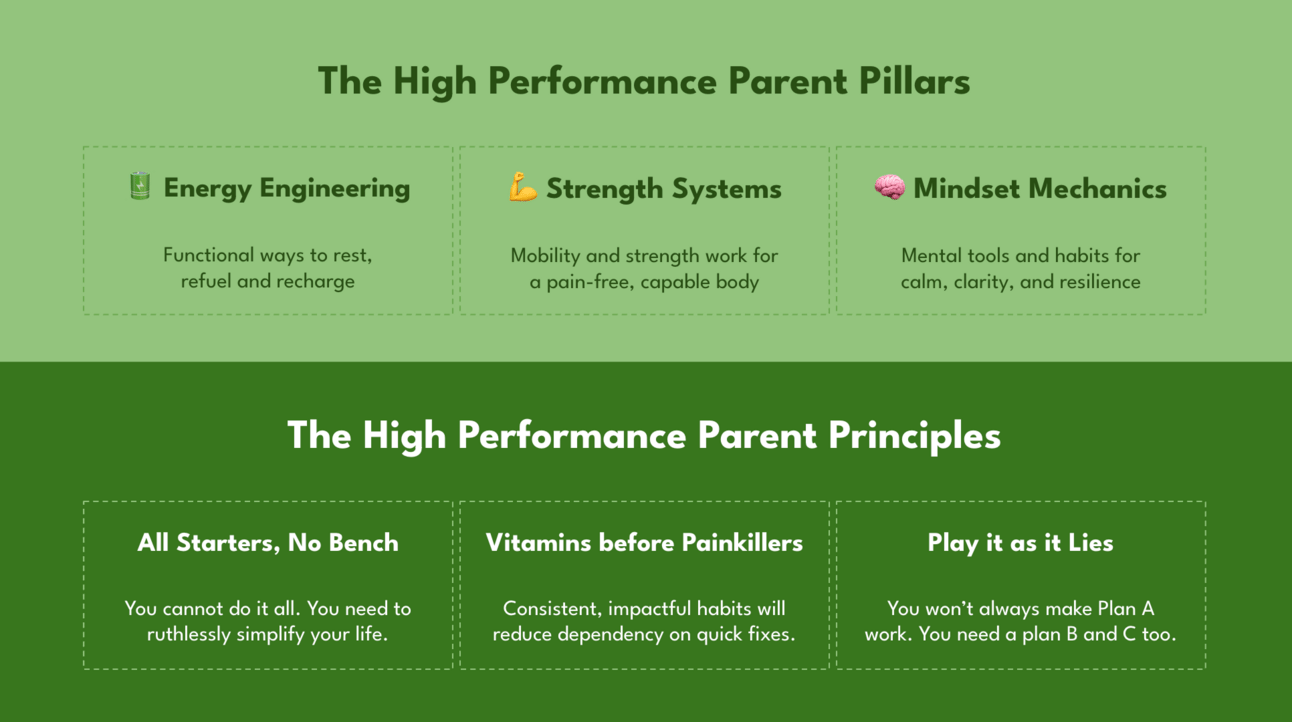
Pillars are the building blocks of the HPP approach. Think of pillars as your core systems or engines - the fundamental areas for investment if you wish to perform at your best. Together, they form the scaffolding for a high performance life, and if neglected will ultimately lead to detrimental outcomes, such as burnout.
🔋 Energy Engineering
Energy engineering is about finding ways to rest and recharge. I think we all instinctively know what ‘low energy’ feels like as a parent. And I think most of us also recognise that it’s not as simple as “feeling tired”. Energy transcends just physical tiredness. It’s mental, emotional, and spiritual tiredness too.
There are a lot of levers we’re able to pull for boosting energy - from nutrition, to exercise, to mental rest, and more. This is about finding the most meaningful and efficient ways to improve energy. A few questions I’ve chewing over already:
In a world of volatile and reduced sleep, how can I ensure the sleep I do get is as valuable as possible?
Assuming it was a choice, what is more beneficial to my energy levels - more sleep and no exercise, or less sleep and some exercise?
What is the most accessible and meaningful way to give my mind a rest for just 5 minutes?
💪 Strength Systems
Strength systems is about building and maintaining a pain-free, capable body. Parenting is physically demanding stuff. Even as someone who trains a good few times a week, I’ve been surprised at just how often I experience back pain, neck pain, and more as a result of holding and lifting my little one - and as such it becomes a barrier to building habits around training.
The context of parenting demands a step change in our attitudes towards strength and mobility - in particular not just what we train but how we train too. I want to help you find the best ways to feel strong without a few hours in the gym every other day. Here’s a few of my early curious questions:
What is the most mindful way to lift and hold an infant that is both comfortable and also reduces stress on the shoulders and lower back?
How can we use play with our toddlers as an opportunity to strength train?
What is the most meaningful way to recover from or mitigate the symptoms of lower back pain?
🧠 Mindset Mechanics
Mindset Mechanics is about having the mental tools and habits for calm, clarity, and resilience. This for me is arguably the pillar with the largest scope and in turn the most potential. Becoming a parent is a monumental mindset shift.
Ego, identity, control, emotional regulation, prioritisation, compromise, interdependence - these are just a few of the domains tested and unpacked by parenthood, any of which are brand new territory for a lot of us to confront. A few questions I’m already chewing over:
How can I redefine ambition and success in my career as someone who also wants to the very best for their kids?
How can I define boundaries that ensure work doesn’t impact parenting, and vice versa?
What’s the most effective way to gather yourself and stay calm during an intense toddler tantrum?
It may or may not be obvious to some of you, but there is obviously heavy overlap between these pillars - and that’s probably important. You can’t impact energy without mindset, strength without energy, and so on.
So my current hypothesis is that although each of these domains will have their own bodies of research, the most powerful rituals, protocols and habits will be those informed by all three. One of the many assumptions to test at least!
Now, for our Principles…
Principles v1
Principles are your operating rules. They’re simple, memorable, and practical. When life throws curveballs (and it will!) principles help you respond, not just react. They basically work like shortcuts for better choices. If the pillars are your foundation, the principles are your playbook. You’ll come back to them again and again when the plan breaks or the day derails.
⚽️ All Starters, No Bench
= Simplicity
= You cannot do it all. You need to ruthlessly simplify and focus your life.
It’s become very apparent to me that compromise, flexibility, and change, is absolutely necessary when you become a parent. I’ve found myself deprioritising and reconfiguring a lot - which to some extents is just practical changes, but on a deeper level it’s a tonne of internal work too.
In that spirit, I don’t want any of the protocols or rituals we define to add to the burden of life. They should help contribute to a sense of ruthless focus and simplicity. I think it’s really tough as a parent to have ‘secondary’ goals, habits, priorities - mainly because either a) they are just totally neglected and still take up headspace, or in turn they distract us from our primary ones. We need to make some tough calls on what really matters.
💊 Vitamins before Painkillers
= Consistency
= Sustainable habits should reduce dependency on quick fixes.
Consistency in life as a parent can feel like a battle. But as I reflect on my own experience of trying to maintain good habits, I’ve noticed that I’m often using being a parent as an excuse or justification for bad decisions. Don’t get me wrong, ordering a takeaway after no sleep and a 12 hour working day - I’ll give myself some grace. But getting a takeaway with a fridge full of good food that’s quick to prepare after a low key working day - yeah that’s a bit of a cop out.
Ultimately, the belief here is that although “painkillers” are somewhat inevitable - and can be invaluable for short term relief - they are not a sustainable choice. If we can commit ourselves to sustainable habits (that may not provide us with the same notable “relief” as a painkiller), the assumption here is it will reduce or mitigate the need for painkillers in the long run.
⛳️ Play it as it Lies
= Adaptability
= You won’t always make Plan A work. You need a plan B and C too.
I’m great at defining my Plan A’s - and a high chance you are too. But even before I became a parent, I found myself failing to always match my intentions with the appropriate action. This has of course been exacerbated by becoming a parent, and even despite my best efforts, I struggle to stick with my plans when time and energy escape me.
This is where I think the word intention is important. My intention isn’t necessarily to follow a very specific and rigid plan (e.g. do this very structured workout) - it’s typically about a more general idea, something I believe to be important (e.g. “I want to move my body”). In effect once we’ve clarified our intention, we’re able to understand the variety of ways in which we can fulfil that intention that take into account our context. Some days it will be the 2 hours in the gym, other days it will be 20 press ups and a few crunches. We need to get clear on what our fallbacks look like in order to ensure we don’t need to reinvent the wheel every context change.
And that’s your lot - for now! This will evolve with every new conversation, every new piece of research, every new experiment, but it gives us a starting point. I’d be encouraging you all the use this as a model for reflecting on your own current attitude and approach. Here’s a few questions to help:
What do I do each day that I know drains my energy - and why?
Where in my daily routine do I unconsciously compromise my physical well-being, and how could I reframe that moment as a chance to strengthen instead?
What belief or identity am I holding onto that no longer serves me as a parent - and what might it look like to let it go?
If I could only focus on 3 priorities for the next 3 months, what would they be - and what would I need to stop doing to make space for them?
What short term relief do I regularly reach for that could be replaced with a longer term habit if I committed for just one week?
What intention do I keep failing to meet because the plan is too rigid - and how could I design a flexible fallback that still honours that intention?
That’s your lot for this week. I promise in not too long we’ll start getting into the nitty gritty, but hope you’re all at least enjoying some of this context and framing unfold. Any feedback at all is most welcome.
Catch you next week!
Carl